
Section 47 and Strategy Discussion
Scope of this chapter
This chapter provides the steps for how to undertake a strategy discussion/meeting and how to conduct Section 47 Enquires.
Amendment
This chapter was refreshed in May 2026.
A section 47 enquiry is initiated to decide whether, and what type of, action is required to safeguard and promote the welfare of a child/young person who is suspected to be suffering, or is likely to suffer, significant harm. All practitioners are alert to potential indicators of abuse, neglect, and exploitation, and listen carefully to the voice of the child, including what a child/young person says, how they behave, and how they communicate if non-verbal (due to age, special needs and/or disabilities, or if unwilling to communicate). All practitioners will try to understand the child/young person's personal experiences and observe and record any concerns.
Responsibility for undertaking Section 47 enquiries (under section 47 Children Act 1989) lies with the Local Authority, Children's Services, in whose area the child/young person lives or is found. 'Found' means the physical location where the child/young person suffers the incident of harm or neglect (or is identified as likely to suffer harm or neglect), e.g. nursery or school, boarding school, hospital, one-off event, such as a festival, holiday home or outing or where a privately fostered or looked after child/young person is living with their carers.
The Local Authority in whose area a child/young person is found in circumstances that require emergency action (the first authority) is responsible for taking emergency action. If the child/young person is looked after by, or the subject of a child protection plan in another authority, the first authority must consult the authority responsible for the child/young person. Only when the second Local Authority explicitly accepts responsibility (to be followed up in writing) is the first authority relieved of its responsibility to take emergency action.
Local Authority social workers have a statutory duty to lead enquiries under Section 47 of the Children Act 1989. The Police, health practitioners, teachers and other school staff and other relevant practitioners should support them in undertaking the enquiries.
Each agency has a duty to assist and provide information in support of child protection enquiries. When requested to do so by Children's Services, practitioners from other parts of the Local Authority such as housing, schools and those in health organisations have a duty to cooperate under Section 27 of the Children Act 1989 by assisting the Local Authority in carrying out its Children's Services functions.
See: Information Sharing and Confidentiality Procedure.
The Lead Practitioner should always be a qualified Social Worker for child protection enquiries. S.47 Enquiries must be completed within 15 working days, the decision to progress to an initial child protection case conference will be made by day 8. The C&F assessment will have commenced at the point of receipt of referral, and it must continue whenever the criteria for Section 47 Enquiries are satisfied. The conclusions and recommendations of the Section 47 Enquiry should inform the assessment which must be completed within 45 working days of the date when the referral was received. If agency checks have not been received back in time and have been chased by the social worker, then the escalation process. Please see 4.5.3 Resolution of Professional Differences, including Escalations should be initiated for that agency. If there is sufficient information on which to base the analysis of harm and risk, then this will be considered. However, all efforts must be taken to ensure that multi agency information is gathered at the earliest opportunity.
The enquiries and assessment should always involve separate interviews with the child/young person and, in most situations, the parents/carers, and the observation of interaction between the parent/carer and child/young person. This will include interviews and observations of parents, any other carers and the partners of the parents. Practitioners should explain to parents or carers the purpose, process and potential outcome of the enquiries and be prepared to answer questions openly, unless to do so would significantly negatively impact the safety and welfare of the child/young person.
Where there is a risk to the life of a child/young person or the likelihood of serious immediate harm, whether from inside or outside the home, the Police (including the British Transport Police) and Children's Services should act immediately to secure the immediate safety of the child/young person.
- If it is necessary to remove a child/young person from their home, a Local Authority must, wherever possible and unless a child/young person's safety is otherwise at immediate risk, apply for an Emergency Protection Order (EPO). Police Powers of Protection (PPO) should only be used in exceptional circumstances where there is risk to the immediate safety of the child/young person. Where Police have exercised their Powers of Protection, Section 47 Enquiries will commence with immediate effect;
- When considering whether emergency action is required, an agency will always consider whether action is required to safeguard and promote the welfare of other children/young people in the same household (e.g. siblings), the household of an alleged perpetrator, or elsewhere;
- See Working Together to Safeguard Children, Flowchart 3: Immediate Protection;
- Planned emergency action will normally take place following an immediate strategy discussion/meeting between Police, Children's Services, health practitioners and other agencies as appropriate.
Children Services and Police should:
Initiate a multi-agency strategy discussion to discuss planned emergency action. Where a single agency must act immediately, a strategy discussion should take place as soon as possible after action has been taken. Wherever there are concerns of immediate significant harm, urgent legal advice should be sought.
Whenever there is reasonable cause to suspect that a child/young person is suffering, or is likely to suffer, significant harm, there should be a strategy discussion as soon as possible involving Local Authority Children's Services, the Police, health, education, and other agencies, such as the referring agency, early help, or other practitioners involved in supporting the child/young person. A paediatrician should be present when there are concerns that require a Child Protection Medical. The Sexual Abuse Referral Centre (SARC) should also be present where there are concerns of sexual abuse - including when concerns are historic in nature or not resulting in physical injury. In the case of a pre-birth strategy discussion/meeting this should involve the midwifery services. Please see Prebirth Protocol.
Appropriate health representation needs to be considered for the Strategy meeting. Please invite mental health practitioners if it is known that they are working with a child or parent, particularly if mental health practitioners made the referral.
The purpose of the strategy discussion/ meeting is to:
- Consider the child/young person's welfare and safety, including through speaking to the child/young person, and identifying whether the child/young person is suffering or likely to suffer significant harm;
- Decide what information should be shared with the child/young person and family (on the basis that information is not shared if this may jeopardise a Police investigation or place the child at risk of harm). Where a Strategy meeting is held by Children's Services and the concerns are linked to a professional that has been referred to the LADO Service, discussion should be held with the LADO prior to sharing any information to the child/young person or parents/family;
- Agree what further action is required by each agency with clear timescales.
Some examples of circumstances where a strategy discussion/meeting should be considered:
- Any information that a child/young person may be likely to suffer, or has suffered significant harm including sexual, physical or emotional abuse, neglect or ongoing exposure to domestic abuse including controlling or coercive behaviour, exploitation by criminal gangs or organised crime groups, trafficking, online abuse, sexual exploitation, and the influences of extremism which could lead to radicalisation;
- When an adult or young person assessed as presenting a risk to children has moved into, or is about to move into, the child/young person's household or such a person is regularly visiting or about to have sustained contact with the child/young person;
- When the likelihood of significant harm to an unborn child may be such as to indicate the need to develop a Child Protection Plan before birth;
- When the death of a child/young person in the family, in which abuse or neglect is suspected, is confirmed and there are other children/young people in the household;
- When a child/young person lives in, or is born to, a household in which resides another child/young person who is currently supported by a Child Protection Plan; fabricated or induced illness, forced marriage, child abduction or missing;
- Where there is sexual activity or sexualised behaviour between children/young people within the same household where one or both are over the age of 10. If both children are under 10 a strategy discussion will be considered on an individual basis, considering additional risk factors.
(This is not an exhaustive list).
Children's Services should:
- Convene the strategy discussion/meeting when there are concerns that a child/young person has or is likely to suffer significant harm;
- Where the concerns relate to a professional who has been referred to the LADO service, an initial response from the LADO should not delay Children's Services holding the strategy discussion/meeting when it is clear immediate actions to secure the child's safety/arrange a child protection medical and discuss any police action are needed;
- Ensure all relevant agencies and practitioners are invited, including the referring agency;
- Ensure discussion is documented and the record of the notes and decisions authorised by the Children's Service's Manager and should be circulated within 1 full working day (24 hours) or as soon as practicable to all agencies in the discussion.
Health practitioners should:
- Provide any specific information from relevant practitioners regarding family health, maternity health, school health, mental health, domestic abuse and violence, and substance misuse to assist strategy and decision making;
- Secure additional expert advice and support from named and/or designated professionals for more complex situations following preliminary strategy discussions;
- Undertake appropriate examinations or observations, and further investigations or tests, to determine how the child/young person's health or development may be impaired;
- Paediatrician or their representative to advise about the appropriateness of any potential Child Protection Medicals - a safeguarding doctor should be invited to any Strategy Meeting where a Child Protection Medical is being considered.
The Police should:
- Discuss the basis for any criminal investigation, including both reactive (where there is evidence to suggest a crime has been committed) and proactive (where further activity is required to establish if a crime has occurred), and any relevant processes that other organisations and agencies might need to know about, including the timing and methods of evidence-gathering.
- Lead the criminal investigation where joint enquiries with Children's Services are being undertaken and Section 47 enquiries and a C&F assessment are being completed.
If the child/young person is in hospital, decisions should also be made about how to secure the safe discharge of the child/young person.
Outcomes:
The plan made at the first strategy discussion/meeting should reflect the requirement to convene an Initial Child Protection Conference within 15 working days. When Children's Services have concluded that an Initial Child Protection Conference is not required but practitioners in other agencies remain seriously concerned about the safety of a child, these practitioners should seek further discussion with the Lead Practitioner. Likewise, if agencies are concerned about the decision not to undertake a medical examination, then this should be escalated in line with the escalation policy.
Please see 4.5.3 Resolution of Professional Differences, including Escalations.
If the conclusion of the strategy discussion/meeting is that there is no cause to pursue the Section 47 Enquiry, then consideration should be given to continuing a multi-agency assessment to meet the needs of the child/young person, for any Early Help support services or to provide family support services to them as a Child in Need.
See Working Together to Safeguard Children, Flowchart 5: Action Following a Strategy Meeting.
Where Children's Services have held a strategy discussion/meeting.
All practitioners should work collaboratively and proactively with multi-agencies to build an accurate and comprehensive understanding of the daily life of a child/young person and their family to establish the likelihood of significant harm and any ongoing risks.
Children's Services should:
- Lead the assessment in accordance with the guidance Working Together to Safeguard Children;
- Carry out enquiries in a way that minimises distress for the child/young person and family;
- See the child/young person within 24hrs of the Strategy Discussion who is the subject of concern to ascertain their wishes and feelings, assess their understanding of their situation, assess their relationships and circumstances more broadly, and understand the child/young person's experiences and interactions with others;
- Consider whether a joint enquiry or single agency may need to speak to a child/young person victim without the knowledge of the parent or carers;
- Explain to parents or carers the purpose, process and potential outcome of the enquiries, unless to do so would significantly negative impact the safety and welfare of the child/young person;
- Interview parents or carers and determine the wider social and environmental factors that might impact on them and their child;
- Systematically gather information about the child/young person's and family's history;
- Analyse the findings of the assessment and evidence about what interventions are likely to be most effective with other relevant practitioners in a timely manner avoiding drift;
- Determine the child/young person's needs and the level of risk of harm for the child/young person to inform what help should be provided and act to provide that help;
- Follow the guidance set out in Achieving Best Evidence in Criminal Proceedings: Guidance on Interviewing Victims and Witnesses and Guidance on Using Special Measures where a decision has been made to undertake a joint interview of the child/young person as part of any criminal investigation.
Health practitioners should:
- Provide appropriate specialist assessment by the appropriate doctor where required, such as a Child Protection Medical assessment. A medical assessment is required if there are concerns that a child/young person has suffered physical abuse, sexual abuse or neglect;
- The child/young person may have medical needs which do not merit a Child Protection Medical. The health practitioner should follow up with the appropriate agency to ensure intervention is in place to address any identified needs;
- Ensure appropriate treatment and follow-up for any identified unmet health concerns.
The Police should:
- Decide whether Police investigations reveal grounds for instigating criminal proceedings;
- Make available to other practitioners any other relevant information gathered or known to inform discussions about the child/young person's welfare;
- Follow the guidance set out in Achieving Best Evidence in Criminal Proceedings: Guidance on Interviewing Victims and Witnesses and Guidance on Using Special Measures where a decision has been made to undertake a joint interview of the child/young person as part of the criminal investigation.
Working Together to Safeguarding Children 2023 provide that:
Practitioners should:
- All practitioners satisfy themselves that conclusions about the likelihood of significant harm give sufficient weight to the views, experiences, and concerns of those who know the child and/or parents well, including relatives who are protective of the child, and other relevant practitioners;
- Practitioners share their thinking and proposed recommendations with other practitioners who hold relevant information and insight into the child and adults involved with the child. Practitioners comment, challenge, and jointly deliberate, before making a final decision about the likelihood of significant harm;
- Together with other agencies, practitioners clarify what family help from multi- agency partners is necessary to reduce the likelihood of significant harm and maintain reasonable care for the children. They seek assurance that this resource is available and of sufficient skill and intensity;
- Practitioners explain clearly to parents and the family network the implications of the threshold that has been reached for section 47 enquiries, the initial child protection conference, and any ongoing child protection plan (including that this threshold may lead to pre-proceedings, should the likelihood of significant harm not reduce). Practitioners do everything they can to ensure that parents and the family network understand and can engage purposefully with the enquiries and any protection plan;
- Practitioners remain alert to changes in circumstances for the child and family and respond as new information comes to light that needs to be reflected in the child protection plan;
- Practitioners reflect on the proposed protection plan and consider adjustments to strengthen the protection plan. The protection plan is specific, achievable, and relevant to the likelihood of significant harm and the context in which it is occurring.
The assessment of risk will:
- Identify the cause for concern, its seriousness, any recurring events and the vulnerability and resilience of the child/young person;
- Evaluate the strengths, including the protective factors, and weaknesses of the family;
- Evaluate the risks to the child/young person and the context in which they are living;
- Consider the child/young person's needs for protection; from whom and how;
- Consider the capacity of the parents/carers and wider family and social networks to safeguard and promote the child/young person's welfare - this should include both parents, any other carers, such as grandparents, and the partners of the parents;
- Consider risk factors that may suggest a higher level of vulnerability in the family and risk of significant harm such as parental mental health difficulties, parental substance misuse, and domestic abuse or combinations of these;
- Determine the level of intervention required to improve the outcome for the child/young person to be safeguarded in the immediate, interim and longer term.
You should approach the work with parents and carers in line with the principles of a child-centred approach within a whole family focus set out in Working Together to Safeguard Children.
- Practitioners should take care to ensure that the child/young person know what is being discussed about them and their family where this is appropriate. They should capture and incorporate the voice of the child/young person in their own words as much as possible, ask the child/young person what they would like to happen and what they think would help them and their family to reduce the likelihood of significant harm, including where harm is taking place in contexts beyond the family home;
- Children/young people who are supported through Section 47 Enquiries should always be seen and communicated with alone by the social worker, subject to their age and willingness, preferably with parental permission, initially with 24hrs of the Strategy Discussion. The discussions with the child/young person should be conducted in a way that minimises distress to them and maximises the likelihood that they will provide accurate and complete information, avoiding leading or suggestive questions. All children/young people within the household, including those who regularly visit, must be directly communicated with during Section 47 Enquiries by either the Police or Children's Services or both agencies, to enable an assessment of their safety to be made. See Good Practice in Supporting the Voice of the Child;
- If the child/young person is the subject of ongoing court proceedings, legal advice must be sought about obtaining permission from the court to see the child/young person. Children's Services and the Police should ensure that appropriate arrangements are in place to support the child/young person through the Section 47 Enquiry. Specialist help may be needed if:
- The child/young person's first or fluent language is not English;
- The child/young person appears to have a degree of mental health concerns/needs;
- The child/young person has a physical/sensory/learning disability /neurodivergence;
- Interviewers do not have adequate knowledge and understanding of the child/young person's ethnic, faith and cultural background.
- If the whereabouts of a child/young person subject to Section 47 Enquiries are unknown and cannot be ascertained by Children's Services, the following action must be taken within 24 hours:
- A strategy discussion/ meeting with the Police;
- Agreement reached with Children's Services responsible as to what further action is required to locate and see the child/young person and carry out the enquiry.
If access to a child/young person is refused or obstructed, Children's Services should co-ordinate a strategy discussion/meeting including legal representation, to develop a plan to locate or access the child/young person and progress the Section 47 Enquiry.
Practitioners should engage parents, all those with Parental Responsibility and the family network, as appropriate, in the discussions, recognising previous involvement with agencies and services may influence how they engage. Practitioners should encourage parents and families to express what support would help them to reduce significant harm.
Practitioners should thoroughly explore the significance of the adults in contact with the child/young person and their family or individual histories. They should pay particular attention to any serious criminal convictions, previous allegations of child abuse, domestic abuse or impulsive violent behaviour, restrictions on contact with children/young people or involvement with children/young people subject to child protection plans or care proceedings.
Practitioners should explain clearly to parents/carers, all those with Parental Responsibility and the family network the implications of the threshold that has been reached for section 47 enquiries, the Initial Child Protection Conference, and any ongoing child protection plan (including that this threshold may lead to pre-proceedings, should the likelihood of significant harm not reduce). All practitioners involved with the family should do everything they can to ensure that parents/carers and the family network understand and can engage purposefully with the enquiries and any protection plan.
If a parent/carer has a specific communication difficulty or English is not their first language, an interpreter should be provided.
Children's Services has the main responsibility to engage with parents/carers, those with Parental Responsibility and other family members to ascertain the facts of the situation causing concern and to assess the capacity of the family to safeguard the child/young person.
Parents/carers and those with Parental Responsibility should be involved at the earliest opportunity unless to do so would jeopardise a Police investigation or place the child/young person at risk of harm. The needs and safety of the child/young person will be paramount when determining at what point parents or carers are given information. Parents/carers must be kept informed throughout about the enquiry, the outcome and any subsequent action unless this would jeopardise a Police investigation or place the child/young person at risk of harm.
The C&F assessment should include all parents, those with Parental Responsibility any other carers such as grandparents and the partners of the parents, as applicable. Where a parent/carer lives elsewhere but has contact with the child/young person, arrangements should be made for their involvement in the assessment process.
Appropriate checks should be completed on an adult who assumes the care of a child during a Section 47 Enquiry.
An explanation of their rights as parents/carers, including the need for support and guidance from an advocate whom they trust, should be provided, including advice about the right to seek legal advice.
Any objections or complaints expressed by parents during a Section 47 Enquiry, and the response to these objections or complaints, must be clearly recorded.
Strategy discussions/meetings must consider, in consultation with the named Doctor/ Paediatrician (if not part of the strategy discussion/meeting), the need for and the timing of a Child Protection Medical. Child Protection Medicals should always be considered where there has been a report or there is a suspicion of any form of abuse to a child/young person.
All children/young people in the household should be considered/offered a Child Protection Medical. If a Child Protection Medical has not been carried out on the other children/young people in the household, this must be recorded on the strategy discussion with the rationale.
A Child Protection Medical should demonstrate a holistic approach to the child/young person and assess the child/young person's well-being, including mental health, development and cognitive ability.
A Child Protection Medical is necessary to:
- Secure forensic evidence;
- Obtain medical documentation;
- Provide reassurance for the child/young person and parent/carer;
- Inform treatment follow-up and review for the child/young person (any injury, infection, new symptoms including psychological).
Only doctors may physically examine the whole child. All other staff should only note any visible marks or injuries on a body map and record, date and sign details in the child/young person's file.
If agencies are concerned about the decision not to undertake a medical examination, then this should be escalated in line with the escalation policy.
Please see Resolution of Professional Differences, including Escalations.
The following may give consent to a Child Protection Medical:
- A child of sufficient age and understanding (Gillick competency/Fraser guidelines). A child/young person of any age who has sufficient understanding (generally to be assessed by the doctor with advice from others as required) to make a fully informed decision can provide lawful consent to all or part of a Child Protection Medical or emergency treatment;
- A young person aged 16 or 17 has an explicit right (s8 Family Law Reform Act 1969) to provide consent to surgical, medical or dental treatment and, unless grounds exist for doubting their mental health, no further consent is required;
- A child/young person who is of sufficient age and understanding may refuse some or all of a Child Protection Medical, though refusal can potentially be overridden by a court;
- Any person with Parental Responsibility, providing they have the capacity to do so;
- The Local Authority when the child/young person is the subject of a care order (though the parent/carer should be informed);
- The Local Authority when they are the child/young person's corporate parent under mandatory section 20 accommodation because "there are no persons with parental responsibility for the child" or "the child is lost or abandoned";
- The High Court when the child/young person is a Ward of Court;
- A Family Court as part of a direction attached to an Emergency Protection Order, an Interim Care Order or a Child Assessment Order;
- Wherever possible the permission of a parent/carer should be sought for children/young people aged 15 years old or under, prior to any Child Protection Medical and/or other medical treatment.
Where circumstances do not allow permission to be obtained and the child/young person needs life or limb saving medical treatment, the medical practitioner may:
- Regard the child/young person to be of an age and level of understanding to give their own consent;
- Decide to proceed without consent.
In these circumstances, parents/carers must be informed by the medical practitioner as soon as possible and a full record must be made at the time.
In non-emergency situations, when parental permission is not obtained, the social worker, in consultation with their manager, will consult with the Child Litigation Unit to consider whether it is in the child/young person's best interests to seek a court order.
During Section 47 Enquiries, appropriately trained and experienced practitioners must undertake all Child Protection Medicals, i.e. Paediatricians, SARC practitioners. NB: GPs cannot carry out Child Protection Medicals and a family should not be directed to a GP.
A report should be provided by the examining doctor to Children's Services, the GP and where appropriate, the Police. See The Royal College of Paediatrics and Child Health (RCPCH) Child Protection Service Delivery Standards.
The report should include:
- A verbatim record of the parent/carer's and child/young person's accounts of injuries and concerns noting any discrepancies or changes of story;
- Documentary findings in both words and diagrams;
- Site, size and shape of any marks or injuries;
- Opinion of whether injury is consistent with explanation;
- Date, time and place of examination;
- Those present;
- Who gave consent and how (child/young person/parent, written/verbal);
- Other findings relevant to the child/young person (e.g. squint, learning or speech problems etc.);
- Overview of the child/young person's developmental progress (especially important in cases of neglect);
- The time the examination ended.
All reports and diagrams should be signed and dated by the doctor undertaking the examination.
Visually recorded interviews must be planned and conducted by trained Police officers in accordance with the Achieving Best Evidence in Criminal Proceedings: Guidance on interviewing victims and witnesses, and guidance on using special measures (Ministry of Justice). All events up to the time of the video interview must be fully recorded. Consideration of the use of video-recorded evidence should consider situations where the child/young person has been subject to abuse using recording equipment. Achieving Best Evidence promotes a strong victim-centred and trauma-informed approach throughout the guidance. It covers the interview process for child/young person and adult victims and witnesses during a criminal investigation, the pre-trial preparation process, and the support available to witnesses in court.
Visually recorded interviews serve two primary purposes:
- Evidence gathering for criminal proceedings;
- Examination in chief of a child witness.
Relevant information from this process can also be used to inform Section 47 Enquiries, subsequent civil childcare proceedings, or disciplinary proceedings against adults, where allegations have been made.
See: Achieving best evidence in criminal proceedings - GOV.UK.
The social worker and their manager are responsible for deciding what action to take and how to proceed, following section 47 enquiries. They should make these decisions based on multi-agency discussions informed by the voice of the child.
It is important that they ensure that both immediate risk assessment and long-term risk assessment are considered. Where the child/young person's circumstances are about to change, the risk assessment must include an assessment of the safety of the new environment (e.g. where a child/young person is to be discharged from hospital to home the assessment must have established the safety of the home environment and implemented any support plan required to meet the child/young person's needs).
The outcome of the Section 47 Enquiries may reflect that the original concerns are:
- Not substantiated; although consideration should be given to whether the child/young person may need services as a Child in Need;
- Substantiated and the child/young person is judged to be suffering, or likely to suffer, significant harm and an Initial Child Protection Conference or legal steps should be considered.
Children's Services Lead Practitioners should:
- Discuss the case with the child/young person, parents/carers, those with Parental Responsibility and other practitioners and be prepared to answer questions openly and be clear on next steps;
- Where necessary and agreed, coordinate support for the children, young people and their families;
- Confirm the arrangements to review any support services implemented;
- Where ongoing intervention from Children's Services has been agreed, consider referral for a family group conference, to determine ongoing support for the child and family. See Family Network and Family Group Decision Making Procedure (including Family Group Conferences).
All involved professionals should:
- Participate in further discussions as necessary;
- Contribute to the development of any plan as appropriate;
- Provide services as specified in the plan for the child/young person;
- Review the impact of services delivered as agreed in the plan;
- Approach the work with parents and carers in line with the principles of a child-centred approach within a whole family focus set out in chapter 1 of Working Together to Safeguard Children;
- Seek advice and guidance as required and in line with local practice guidance;
- Consider the plans for ongoing assessment and reviewing the child/young person's circumstances.
Arrangements should be noted for future referrals, if appropriate.
Children's Services Lead Practitioner should:
- Convene an Initial Child Protection Conference. The Initial Child Protection Conference should take place within 15 working days of a strategy discussion, or the strategy discussion at which section 47 enquiries were initiated if more than one has been held;
- The request for an Initial Child Protection Conference must be submitted by the social worker to the Child Protection Team no later than day 8 of the S47 Enquiry;
- Suitable multi-agency arrangements must be put in place to safeguard the child/young person until such time as the Initial Child Protection Conference has taken place. The social worker and their manager, in consultation with the Child Protection Conference Chair, will coordinate and review such arrangements;
- Consider which practitioners with specialist knowledge or relevant professional disciplines should be invited to participate in the Initial Child Protection Conference so that the plan will meet the child/young person's needs;
- Support the child/young person and their parents/carers to understand the purpose of the Initial Child Protection Conference and who will attend. Parents/carers should be given appropriate information to support their participation in the conference;
- Help prepare the child/young person if they are attending or making representations through a third party to the conference;
- Give information about advocacy agencies and explain that the family may bring an advocate, friend or supporter;
- Ensure the Child and Family Assessment report for conference is shared with the parents/carers a minimum of 2 working days in advance;
- Where concerns that a professional has harmed a child are substantiated through Section 47 enquiries, and there are no concerns linked to the parent/carers of the child an Initial Child Protection Conference would not automatically be required. The outcome and findings from the Section 47 enquires should be shared with the LADO and will be considered as part of any LADO meeting to discuss actions to address and manage risk in the workplace of the professional and the environment in which the child/young person may continue to receive services such as education or care.
All involved practitioners should:
- Complete a full written record using the required agency proforma, authorised and dated by the staff. Full written reports to be sent to Childprotection.unit@hertfordshire.gov.uk;
- Contribute to the information their agency provides ahead of the Initial Child Protection Conference, setting out the nature of the agency's involvement with the child/young person and family;
- Offer clear analysis based on their perspective;
- Police attend the conference and take part in decision-making when invited;
- Seek advice and guidance as required and in line with local practice guidance.
All practitioners must never assume that information has already been shared by another professional or family member and always remain open to changing their views about the likelihood of significant harm.
Feedback from Section 47 Enquiries:
- Children's Services is responsible for recording the outcome of the Section 47 Enquiries consistent with the requirements of the recording system. The outcome should be put on the child/young person's electronic record with a clear record of the discussions, authorised by the Children's Services' Service Manager;
- The outcome of the enquiries, including an evaluation of the outcome for the child/young person, should be given to all the agencies who have been significantly involved, for their information and records;
- The parents/carers and children/young people of sufficient age and appropriate level of understanding should be given feedback of the outcome. This information should be conveyed in an appropriate format for younger children and those people whose preferred language is not English. If there are ongoing criminal investigations, the content of the social worker's feedback should be agreed with the Police;
- Feedback about outcomes should be provided to non-professional referrers in a manner that respects the confidentiality and welfare of the child/young person;
- Where the child/young person concerned is living in a residential establishment which is subject to inspection, the relevant inspectorate should be informed.
Where the decision about the outcome of the Section 47 Enquiry is disputed:
If Children's Services decides not to proceed with a Child Protection Conference, then other practitioners involved with the child/young person and family have the right to request that Children's Services convene a conference if they have serious concerns that a child/young person's welfare may not be adequately safeguarded.
Please see Resolution of Professional Differences, including Escalations.
- All practitioners should be aware of the limits and strengths of their personal expertise and agency remit;
- They should work collaboratively and proactively with multi-agency practitioners to build an accurate and comprehensive understanding of the daily life of a child/young person and their family to establish the likelihood of significant harm and any ongoing risks;
- All practitioners should respect the opinions, knowledge and skills of multi-agency colleagues and engage constructively in their challenge;
- All practitioners should consider the severity, duration and frequency of any abuse, degree of threat, coercion, or cruelty, and the cumulative impact of adverse events;
- All practitioners should be aware of significant relationships in the child/young person's world, such as family and kinship networks, extra-familial contexts, (including online);
- All practitioners should take care to ensure that the child/young person knows what is being discussed about them and their family where this is appropriate. In order to capture the voice of the child/young person, they should ask the child/young person what they would like to happen and what they think would help them and their family to reduce the likelihood of significant harm, including where harm is taking place in contexts beyond the family home;
- All practitioners should engage parents and the family network, as appropriate, in the discussions, recognising previous involvement with agencies and services may influence how they can be engaged. Please see Engaging Families when there are challenges for Agencies/Professionals. Practitioners should encourage parents and families to express what support would help them to reduce significant harm;
- All practitioners should thoroughly explore the significance of the adults in contact with the child/young person and their family or individual histories. They should pay particular attention to any serious criminal convictions, previous allegations of child abuse, domestic abuse or impulsive violent behaviour, restrictions on contact with children or involvement with children subject to child protection plans or care proceedings;
- All practitioners should satisfy themselves that conclusions about the likelihood of significant harm give sufficient weight to the views, experiences, and concerns of those who know the child/young person and/or parents well, including relatives who are protective of the child/young person, and other relevant practitioners;
- All practitioners should share their thinking and proposed recommendations with other practitioners who hold relevant information and insight into the child/young person and adults involved with the child/young person. Practitioners should comment, challenge, and jointly deliberate, before making a final decision about the likelihood of significant harm;
- Together with other agencies, all practitioners should clarify what family help from multi- agency partners is necessary to reduce the likelihood of significant harm and maintain reasonable care for the child/young person. They should seek assurance that this resource is available and appropriate for the family;
- All practitioners should explain clearly to parents and the family network the implications of the threshold that has been reached for section 47 enquiries, the Initial Child Protection Conference, and any ongoing child protection plan (including that this threshold may lead to pre-proceedings, should the likelihood of significant harm not reduce). Practitioners should do everything they can to support the parents and the family network to understand so they can engage purposefully with the enquiries and any protection plan;
- All practitioners should remain alert to changes in circumstances for the child/young person and family, respond as new information becomes available and to address this in the child's plan;
- All practitioners should reflect on the proposed plan and consider adjustments to strengthen the plan. The child's plan should be specific, achievable, and relevant to the likelihood of significant harm and the context in which it is occurring.
Practitioners work as part of a multi-agency team to create lasting change for families and ensure the child/young person, parents and family network know that further help and support is available if needed or further concerns arise.
Following a decision to discharge a child protection plan, practitioners ensure that appropriate support is in place for the child/young person and family and respond to changing circumstances and new information.
Where a child/young person becomes looked after, practitioners do this in the most well planned way and that the child/young person, parents and family network are appropriately supported. Ongoing need is monitored as part of care planning.
See also: Children's social care: national framework - Statutory guidance which sets out the principles behind children's social care, its purpose, factors enabling good practice and what it should achieve.
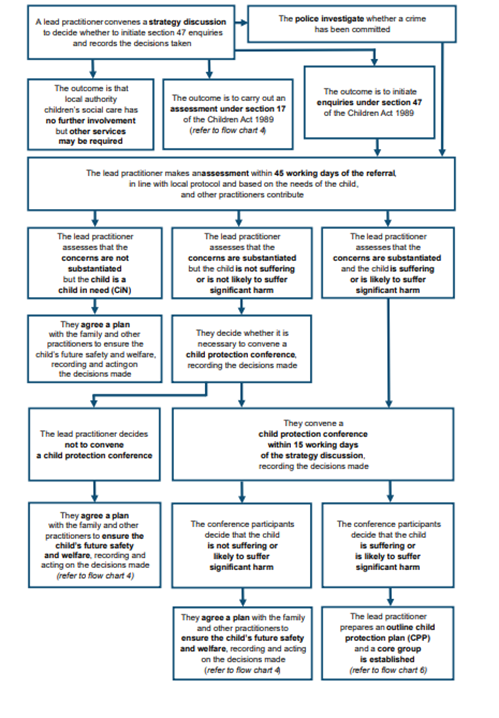
Flowchart: Action following a Strategy Meeting/Discussion (taken from Working Together 2023. Whilst this flowchart is helpful, it does not reflect the role of the Lead Child Protection Practitioner).
Last Updated: May 21, 2026
v74


You can translate the content of this page by selecting a language in the select box.
Copyright © tri.x